
diff options
Diffstat (limited to 'lib/imgui-1.92.6/docs/FONTS.md')
| -rw-r--r-- | lib/imgui-1.92.6/docs/FONTS.md | 637 |
1 files changed, 637 insertions, 0 deletions
diff --git a/lib/imgui-1.92.6/docs/FONTS.md b/lib/imgui-1.92.6/docs/FONTS.md new file mode 100644 index 0000000..1e51cde --- /dev/null +++ b/lib/imgui-1.92.6/docs/FONTS.md @@ -0,0 +1,637 @@ +_(You may browse this at https://github.com/ocornut/imgui/blob/master/docs/FONTS.md or view this file with any Markdown viewer)_ + +## Dear ImGui: Using Fonts + +The code in Dear ImGui embeds a copy of [ProggyClean.ttf](https://github.com/bluescan/proggyfonts) by Tristan Grimmer, +a 13 pixels high, pixel-perfect font used by default. ProggyClean does not scale very nicely. + +The code in Dear ImGui embeds a partial copy of [ProggyForever.ttf](https://github.com/ocornut/proggyforever) by Disco Hello & Tristan Grimmer, +a new font mimicking ProggyClean which does scale nicely. + +We embed fonts in the code so you can use Dear ImGui without any file system access. +If you don't use them you can set `IMGUI_DISABLE_DEFAULT_FONT` in your [imconfig.h](https://github.com/ocornut/imgui/blob/master/imconfig.h) file to ship binaries without the fonts and save about ~26 KB. + +Calling io.Fonts->AddFontDefaultVector() loads ProggyForever. +Calling io.Fonts->AddFontDefaultBitmap() loads ProggyClean. +Calling io.Fonts->AddFontDefault() selects one based on the expected default font size (when `style.FontSizeBase * style.FontScaleMain * style.FontSizeDpi >= 15` we use ProggyForever). + +You may also load external .TTF/.OTF files, see instructions on this page. +In the [misc/fonts/](https://github.com/ocornut/imgui/tree/master/misc/fonts) folder you can find a few suggested fonts, provided as a convenience. + +**Also read the FAQ:** https://www.dearimgui.com/faq (there is a Fonts section!) + +## Index +- [Troubleshooting](#troubleshooting) +- [New! Dynamic Fonts system in 1.92 (June 2025)](#new-dynamic-fonts-system-in-192-june-2025) +- [How should I handle DPI in my application?](#how-should-i-handle-dpi-in-my-application) +- [Fonts Loading Instructions](#fonts-loading-instructions) +- [Loading Font Data from Memory](#loading-font-data-from-memory) +- [Loading Font Data Embedded In Source Code](#loading-font-data-embedded-in-source-code) +- [Using Icon Fonts](#using-icon-fonts) + - [Excluding Overlapping Ranges](#excluding-overlapping-ranges) +- [Using FreeType Rasterizer (imgui_freetype)](#using-freetype-rasterizer-imgui_freetype) +- [Using Colorful Glyphs/Emojis](#using-colorful-glyphsemojis) +- [Using Custom Glyph Ranges](#using-custom-glyph-ranges) +- [Using Custom Colorful Icons](#using-custom-colorful-icons) +- [About Filenames](#about-filenames) +- [About UTF-8 Encoding](#about-utf-8-encoding) +- [Debug Tools](#debug-tools) +- [Credits/Licenses For Fonts Included In Repository](#creditslicenses-for-fonts-included-in-repository) +- [Font Links](#font-links) + +--------------------------------------- + +## Troubleshooting + +**A vast majority of font and text related issues encountered comes from 4 things:** + +### (1) Invalid filename due to use of `\` or unexpected working directory. + +See [About Filenames](#about-filenames). AddFontXXX() functions should assert if the filename is incorrect. + +### (2) Invalid UTF-8 encoding of your non-ASCII strings. + +See [About UTF-8 Encoding](#about-utf-8-encoding). Use the encoding viewer to confirm encoding of string literal in your source code is correct. + +### (3) Missing glyph ranges. + +🆕 **Since 1.92, with an up to date backend: specifying glyph ranges is unnecessary.** + +⏪ Before 1.92: you need to load a font with explicit glyph ranges if you want to use non-ASCII characters. See [Fonts Loading Instructions](#fonts-loading-instructions). Use [Debug Tools](#debug-tools) confirm loaded fonts and loaded glyph ranges. + +This was a previous constraint of Dear ImGui (lifted in 1.92): when loading a font you need to specify which characters glyphs to load. +All loaded fonts glyphs are rendered into a single texture atlas ahead of time. Calling either of `io.Fonts->GetTexDataAsAlpha8()`, `io.Fonts->GetTexDataAsRGBA32()` or `io.Fonts->Build()` will build the atlas. This is generally called by the Renderer backend, e.g. `ImGui_ImplDX11_NewFrame()` calls it. **If you use custom glyphs ranges, make sure the array is persistent** and available during the calls to `GetTexDataAsAlpha8()/GetTexDataAsRGBA32()/Build()`. + +### (4) Font atlas texture fails to upload to GPU. + +🆕 **Since 1.92, with an up to date backend: atlas is built incrementally and dynamically resized, this is less likely to happen** + +:rewind: This is often of byproduct of point 3. If you have large number of glyphs or multiple fonts, the texture may become too big for your graphics API. **The typical result of failing to upload a texture is if every glyph or everything appears as empty white rectangles.** Mind the fact that some graphics drivers have texture size limitation. If you are building a PC application, mind the fact that your users may use hardware with lower limitations than yours. + + + +Some solutions: +- You may reduce oversampling, e.g. `font_config.OversampleH = 1`, this will half your texture size for a quality loss. + Note that while OversampleH = 2 looks visibly very close to 3 in most situations, with OversampleH = 1 the quality drop will be noticeable. Read about oversampling [here](https://github.com/nothings/stb/blob/master/tests/oversample). +- Reduce glyphs ranges by calculating them from source localization data. + You can use the `ImFontGlyphRangesBuilder` for this purpose and rebuilding your atlas between frames when new characters are needed. This will be the biggest win! +- Set `io.Fonts.Flags |= ImFontAtlasFlags_NoPowerOfTwoHeight;` to disable rounding the texture height to the next power of two. + +##### [Return to Index](#index) + +--------------------------------------- + +## New! Dynamic Fonts system in 1.92 (June 2025) + +v1.92 introduces a newer, dynamic font system. It requires backend to support the `ImGuiBackendFlags_HasTextures` feature: +- Users of icons, Asian and non-English languages do not need to pre-build all glyphs ahead of time. Saving on loading time, memory, and also reducing issues with missing glyphs. Specifying glyph ranges is not needed anymore. +- `PushFont(NULL, new_size)` may be used anytime to change font size. +- Packing custom rectangles is more convenient as pixels may be written to immediately. +- Any update to fonts previously required backend specific calls to re-upload the texture, and said calls were not portable across backends. It is now possible to scale fonts etc. in a way that doesn't require you to make backend-specific calls. +- It is possible to plug a custom loader/backend to any font source. + +See [#8465](https://github.com/ocornut/imgui/issues/8465) for more details. + + +##### [Return to Index](#index) + +--------------------------------------- + +## How should I handle DPI in my application? + +Since 1.92, with an updated backend, you can set `style.FontScaleDpi = your_content_scale;` to scale all fonts. +<BR>You can call `style.ScaleAllSizes(xxx)` at init time or every frame at the beginning of your main loop to scale sizes/paddings. +<BR>Since 1.92, with an updated backend, macOS style pixel/backing style scale is automatically handled. +<BR>See [FAQ entry](https://github.com/ocornut/imgui/blob/master/docs/FAQ.md#q-how-should-i-handle-dpi-in-my-application) for more details. + +##### [Return to Index](#index) + +--------------------------------------- + +## Fonts Loading Instructions + +**Select base size** +```cpp +ImGuiStyle& style = ImGui::GetStyle(); +style.FontSizeBase = 20.0f; +``` + +**Load default font:** +```cpp +ImGuiIO& io = ImGui::GetIO(); +io.Fonts->AddFontDefaultVector(); // Load embedded scalable font. +``` +```cpp +io.Fonts->AddFontDefaultBitmap(); // Load embedded bitmap font (legacy). +``` +```cpp +io.Fonts->AddFontDefault(); // Load embedded font (legacy: auto-selected between the two above). +``` + +**Load .TTF/.OTF file with:** + +🆕 **Since 1.92, with an up to date backend: passing a size is not necessary** +```cpp +ImGuiIO& io = ImGui::GetIO(); +io.Fonts->AddFontFromFileTTF("font.ttf"); +``` +:rewind: **Before 1.92, or without an up to date backend:** +```cpp +ImGuiIO& io = ImGui::GetIO(); +io.Fonts->AddFontFromFileTTF("font.ttf", size_pixels); +``` +If you get an assert stating "Could not load font file!", your font filename is likely incorrect. Read [About filenames](#about-filenames) carefully. + +**Load multiple fonts:** +```cpp +// Init +ImGuiIO& io = ImGui::GetIO(); +ImFont* font1 = io.Fonts->AddFontFromFileTTF("font.ttf",); +ImFont* font2 = io.Fonts->AddFontFromFileTTF("anotherfont.otf"); +``` + +In your application loop, select which font to use: +```cpp +ImGui::Text("Hello"); // use the default font (which is the first loaded font) +ImGui::PushFont(font2, 0.0f); // change font, keep current size +ImGui::Text("Hello with another font"); +ImGui::PopFont(); +``` + +**For advanced options create a ImFontConfig structure and pass it to the AddFont() function (it will be copied internally):** +```cpp +ImFontConfig config; +config.OversampleH = 1.0f; +ImFont* font = io.Fonts->AddFontFromFileTTF("font.ttf", size_pixels, &config); +``` + +**Combine multiple fonts into one:** + +🆕 **Since 1.92, with an up to date backend: specifying glyph ranges is unnecessary.** +```cpp +// Load a first font +ImFont* font = io.Fonts->AddFontDefaultVector(); +ImFontConfig config; +config.MergeMode = true; +io.Fonts->AddFontFromFileTTF("DroidSans.ttf", 0.0f, &config); // Merge into first font to add e.g. Asian characters +io.Fonts->AddFontFromFileTTF("fontawesome-webfont.ttf", 0.0f, &config); // Merge into first font to add Icons +``` +:rewind: **Before 1.92, or without an up to date backend:** +```cpp +// Load a first font +ImFont* font = io.Fonts->AddFontDefault(); + +// Add character ranges and merge into the previous font +// The ranges array is not copied by the AddFont* functions and is used lazily +// so ensure it is available at the time of building or calling GetTexDataAsRGBA32(). +static const ImWchar icons_ranges[] = { 0xf000, 0xf3ff, 0 }; // Will not be copied by AddFont* so keep in scope. +ImFontConfig config; +config.MergeMode = true; +io.Fonts->AddFontFromFileTTF("DroidSans.ttf", 18.0f, &config, io.Fonts->GetGlyphRangesJapanese()); // Merge into first font +io.Fonts->AddFontFromFileTTF("fontawesome-webfont.ttf", 18.0f, &config, icons_ranges); // Merge into first font +io.Fonts->Build(); +``` + +**Add a fourth parameter to bake specific font ranges only:** + +🆕 **Since 1.92, with an up to date backend: specifying glyph ranges is unnecessary. All the GetGlyphRangesXXX() functions are marked obsolete.** +```cpp +// Basic Latin, Extended Latin +io.Fonts->AddFontFromFileTTF("font.ttf", size_pixels, nullptr, io.Fonts->GetGlyphRangesDefault()); + +// Default + Selection of 2500 Ideographs used by Simplified Chinese +io.Fonts->AddFontFromFileTTF("font.ttf", size_pixels, nullptr, io.Fonts->GetGlyphRangesChineseSimplifiedCommon()); + +// Default + Hiragana, Katakana, Half-Width, Selection of 1946 Ideographs +io.Fonts->AddFontFromFileTTF("font.ttf", size_pixels, nullptr, io.Fonts->GetGlyphRangesJapanese()); +``` +See [Using Custom Glyph Ranges](#using-custom-glyph-ranges) section to create your own ranges. + +**Example loading and using a Japanese font:** + +🆕 **Since 1.92, with an up to date backend:** +```cpp +ImGuiIO& io = ImGui::GetIO(); +io.Fonts->AddFontFromFileTTF("NotoSansCJKjp-Medium.otf"); +``` + +:rewind: **Before 1.92, or without an up to date backend:** +```cpp +ImGuiIO& io = ImGui::GetIO(); +io.Fonts->AddFontFromFileTTF("NotoSansCJKjp-Medium.otf", 20.0f, nullptr, io.Fonts->GetGlyphRangesJapanese()); +``` + +```cpp +ImGui::Text(u8"こんにちは!テスト %d", 123); +if (ImGui::Button(u8"ロード")) +{ + // do stuff +} +ImGui::InputText("string", buf, IM_COUNTOF(buf)); +ImGui::SliderFloat("float", &f, 0.0f, 1.0f); +``` + +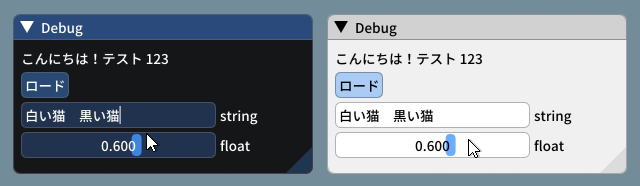 +<br>_(settings: Dark style (left), Light style (right) / Font: NotoSansCJKjp-Medium, 20px / Rounding: 5)_ + +##### [Return to Index](#index) + +--------------------------------------- + +## Loading Font Data from Memory + +```cpp +ImFont* font = io.Fonts->AddFontFromMemoryTTF(data, data_size, size_pixels, ...); +``` + +IMPORTANT: `AddFontFromMemoryTTF()` by default transfer ownership of the data buffer to the font atlas, which will attempt to free it on destruction. +This was to avoid an unnecessary copy, and is perhaps not a good API (a future version will redesign it). +If you want to keep ownership of the data and free it yourself, you need to clear the `FontDataOwnedByAtlas` field: + +```cpp +ImFontConfig font_cfg; +font_cfg.FontDataOwnedByAtlas = false; +ImFont* font = io.Fonts->AddFontFromMemoryTTF(data, data_size, size_pixels, &font_cfg); +``` +IMPORTANT: Since 1.92, when using `FontDataOwnedByAtlas = false`, font data needs to available until `atlas->RemoveFont()`, or more typically until a shutdown of the owning context or font atlas. It was not immediately noticeable in 1.92.0 due to a bug in handling `FontDataOwnedByAtlas = false`, which was fixed in 1.92.6. + +##### [Return to Index](#index) + +--------------------------------------- + +## Loading Font Data Embedded In Source Code + +- Compile and use [binary_to_compressed_c.cpp](https://github.com/ocornut/imgui/blob/master/misc/fonts/binary_to_compressed_c.cpp) to create a compressed C style array that you can embed in source code. +- See the documentation in [binary_to_compressed_c.cpp](https://github.com/ocornut/imgui/blob/master/misc/fonts/binary_to_compressed_c.cpp) for instructions on how to use the tool. +- You may find a precompiled version binary_to_compressed_c.exe for Windows inside the demo binaries package (see [README](https://github.com/ocornut/imgui/blob/master/docs/README.md)). +- The tool can optionally output Base85 encoding to reduce the size of _source code_ but the read-only arrays in the actual binary will be about 20% bigger. + +Then load the font with: +```cpp +ImFont* font = io.Fonts->AddFontFromMemoryCompressedTTF(compressed_data, compressed_data_size, size_pixels, ...); +``` +or +```cpp +ImFont* font = io.Fonts->AddFontFromMemoryCompressedBase85TTF(compressed_data_base85, size_pixels, ...); +``` + +##### [Return to Index](#index) + +--------------------------------------- + +## Using Icon Fonts + +Using an icon font (such as [FontAwesome](http://fontawesome.io) or [OpenFontIcons](https://github.com/traverseda/OpenFontIcons)) is an easy and practical way to use icons in your Dear ImGui application. +A common pattern is to merge the icon font within your main font, so you can embed icons directly from your strings without having to change fonts back and forth. + +To refer to the icon UTF-8 codepoints from your C++ code, you may use those headers files created by Juliette Foucaut: https://github.com/juliettef/IconFontCppHeaders. + +So you can use `ICON_FA_SEARCH` as a string that will render as a "Search" icon. + +🆕 **Since 1.92, with an up to date backend: specifying glyph ranges is unnecessary. You can omit this parameter.** +Example Setup: +```cpp +// Merge icons into default tool font +#include "IconsFontAwesome.h" +ImGuiIO& io = ImGui::GetIO(); +io.Fonts->AddFontDefaultVector(); +ImFontConfig config; +config.MergeMode = true; +config.GlyphMinAdvanceX = 13.0f; // Use if you want to make the icon monospaced +io.Fonts->AddFontFromFileTTF("fonts/fontawesome-webfont.ttf", 13.0f, &config); +``` +:rewind: **Before 1.92:** +```cpp +// Merge icons into default tool font +#include "IconsFontAwesome.h" +ImGuiIO& io = ImGui::GetIO(); +io.Fonts->AddFontDefault(); + +ImFontConfig config; +config.MergeMode = true; +config.GlyphMinAdvanceX = 13.0f; // Use if you want to make the icon monospaced +static const ImWchar icon_ranges[] = { ICON_MIN_FA, ICON_MAX_FA, 0 }; +io.Fonts->AddFontFromFileTTF("fonts/fontawesome-webfont.ttf", 13.0f, &config, icon_ranges); +``` +Example Usage: +```cpp +// Usage, e.g. +ImGui::Text("%s among %d items", ICON_FA_SEARCH, count); +ImGui::Button(ICON_FA_SEARCH " Search"); +// C string _literals_ can be concatenated at compilation time, e.g. "hello" " world" +// ICON_FA_SEARCH is defined as a string literal so this is the same as "A" "B" becoming "AB" +``` +See Links below for other icons fonts and related tools. + +**Monospace Icons?** + +To make your icon look more monospace and facilitate alignment, you may want to set the `ImFontConfig::GlyphMinAdvanceX` value when loading an icon font. +If you `GlyphMinAdvanceX` you need to pass a `font_size` to `AddFontXXX()` calls, as the MinAdvanceX value will be specified for the given size and scaled otherwise. + +**Screenshot** + +Here's an application using icons ("Avoyd", https://www.avoyd.com): +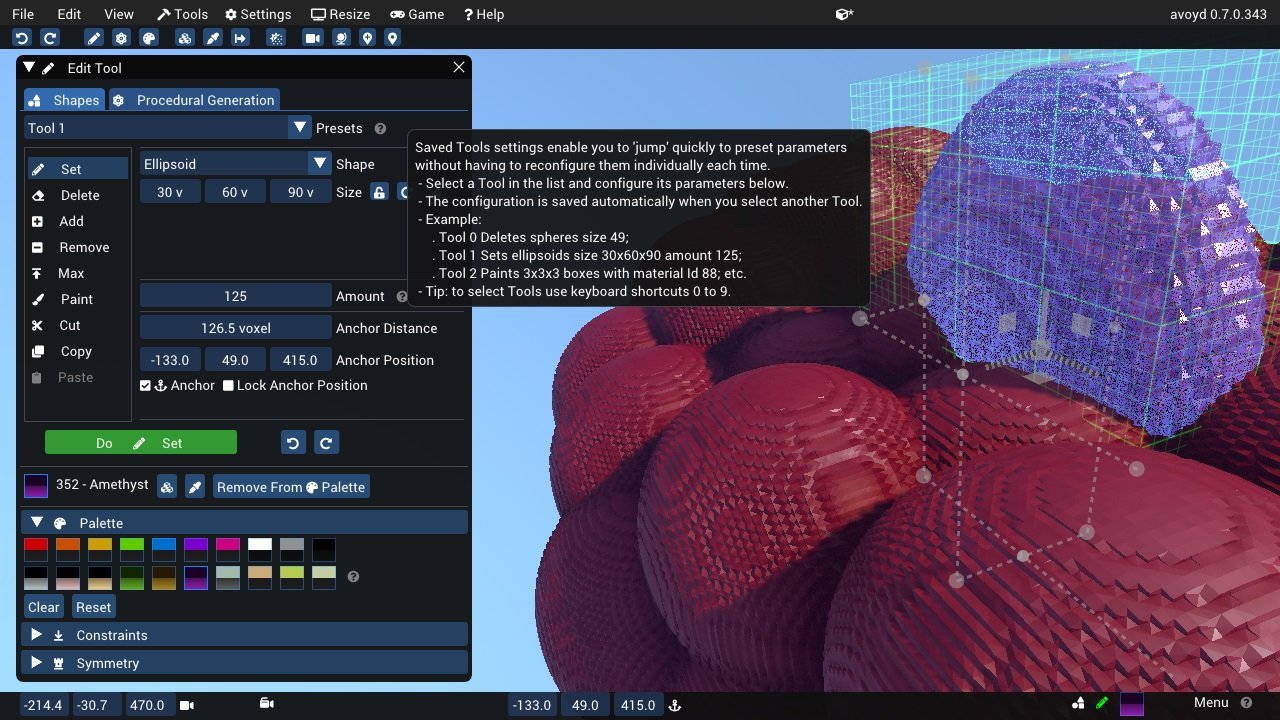 + +##### [Return to Index](#index) + +--------------------------------------- + +### Excluding Overlapping Ranges + +🆕 **Since 1.92, with an up to date backend: glyphs ranges are ignored**: when loading a glyph, input fonts in the merge list are queried in order. The first font which has the glyph loads it. +<BR>‼️ **If you are merging several fonts, you may have undesirable overlapping ranges.** You can use `ImFontConfig::GlyphExcludeRanges[] `to specify ranges to ignore in a given Input. + +```cpp +// Add Font Source 1 but ignore ICON_MIN_FA..ICON_MAX_FA range +static ImWchar exclude_ranges[] = { ICON_MIN_FA, ICON_MAX_FA, 0 }; +ImFontConfig cfg1; +cfg1.GlyphExcludeRanges = exclude_ranges; +io.Fonts->AddFontFromFileTTF("segoeui.ttf", 0.0f, &cfg1); + +// Add Font Source 2, which expects to use the range above +ImFontConfig cfg2; +cfg2.MergeMode = true; +io.Fonts->AddFontFromFileTTF("FontAwesome4.ttf", 0.0f, &cfg2); +``` +Another (silly) example: +```cpp +// Remove 'A'-'Z' from first font +static ImWchar exclude_ranges[] = { 'A', 'Z', 0 }; +ImFontConfig cfg1; +cfg1.GlyphExcludeRanges = exclude_ranges; +io.Fonts->AddFontFromFileTTF("segoeui.ttf", 0.0f, &cfg1); + +// Load another font to fill the gaps +ImFontConfig cfg2; +cfg2.MergeMode = true; +io.Fonts->AddFontFromFileTTF("Roboto-Medium.ttf", 0.0f, &cfg2); +``` + + +You can use `Metrics/Debugger->Fonts->Font->Input Glyphs Overlap Detection Tool` to see list of glyphs available in multiple font sources. This can facilitate understanding which font input is providing which glyph. + +##### [Return to Index](#index) + +--------------------------------------- + +## Using FreeType Rasterizer (imgui_freetype) + +- Dear ImGui uses [stb_truetype.h](https://github.com/nothings/stb/) to rasterize fonts (with optional oversampling). This technique and its implementation are not ideal for fonts rendered at small sizes, which may appear a little blurry or hard to read. +- You can however use `imgui_freetype.cpp` from the [misc/freetype/](https://github.com/ocornut/imgui/tree/master/misc/freetype) folder. Compile with this file and add `#define IMGUI_ENABLE_FREETYPE` to your imconfig.h file or build system to automatically activate it. +- FreeType supports auto-hinting which tends to improve the readability of small fonts. It makes a big difference especially at smaller resolutions. +- Read documentation in the [misc/freetype/](https://github.com/ocornut/imgui/tree/master/misc/freetype) folder. +- Correct sRGB space blending will have an important effect on your font rendering quality. + +##### [Return to Index](#index) + +--------------------------------------- + +## Using Colorful Glyphs/Emojis + +- Rendering of colored emojis is supported by imgui_freetype with FreeType 2.10+. +- You will need to load fonts with the `ImGuiFreeTypeBuilderFlags_LoadColor` flag. +- Emojis are frequently encoded in upper Unicode layers (character codes >0x10000) and will need dear imgui compiled with `IMGUI_USE_WCHAR32`. +- Not all types of color fonts are supported by FreeType at the moment. +- Stateful Unicode features such as skin tone modifiers are not supported by the text renderer. + +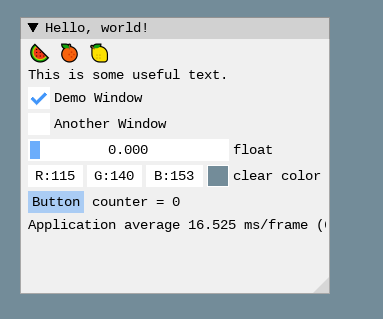 + +```cpp +io.Fonts->AddFontFromFileTTF("../../../imgui_dev/data/fonts/NotoSans-Regular.ttf", 16.0f); +static ImWchar ranges[] = { 0x1, 0x1FFFF, 0 }; +static ImFontConfig cfg; +cfg.MergeMode = true; +cfg.FontLoaderFlags |= ImGuiFreeTypeLoaderFlags_LoadColor; +io.Fonts->AddFontFromFileTTF("C:\\Windows\\Fonts\\seguiemj.ttf", 16.0f, &cfg); +``` + +##### [Return to Index](#index) + +--------------------------------------- + +## Using Custom Glyph Ranges + +🆕 **Since 1.92, with an up to date backend: specifying glyph ranges is unnecessary. Therefore this is not really useful any more.** + +:rewind: You can use the `ImFontGlyphRangesBuilder` helper to create glyph ranges based on text input. For example: for a game where your script is known, if you can feed your entire script to it and only build the characters the game needs. +```cpp +ImVector<ImWchar> ranges; +ImFontGlyphRangesBuilder builder; +builder.AddText("Hello world"); // Add a string (here "Hello world" contains 7 unique characters) +builder.AddChar(0x7262); // Add a specific character +builder.AddRanges(io.Fonts->GetGlyphRangesJapanese()); // Add one of the default ranges +builder.BuildRanges(&ranges); // Build the final result (ordered ranges with all the unique characters submitted) + +io.Fonts->AddFontFromFileTTF("myfontfile.ttf", size_in_pixels, nullptr, ranges.Data); +io.Fonts->Build(); // Build the atlas while 'ranges' is still in scope and not deleted. +``` + +##### [Return to Index](#index) + +--------------------------------------- + +## Using Custom Colorful Icons + +🆕 **Since 1.92, with an up to date backend: this system has been revamped.** + +TL;DR; With the new system, it is recommended that you create a custom `ImFontLoader` and register your fonts with it. +`AddCustomRectFontGlyph()` has been obsoleted because its API does not make much sense with resizable fonts. + +You can ask questions in [#8466](https://github.com/ocornut/imgui/issues/8466). + +:rewind: **Before 1.92:** + +As an alternative to rendering colorful glyphs using imgui_freetype with `ImGuiFreeTypeBuilderFlags_LoadColor`, you may allocate your own space in the texture atlas and write yourself into it. **(This is a BETA api, use if you are familiar with dear imgui and with your rendering backend)** + +- You can use the `ImFontAtlas::AddCustomRect()` and `ImFontAtlas::AddCustomRectFontGlyph()` api to register rectangles that will be packed into the font atlas texture. Register them before building the atlas, then call Build()`. +- You can then use `ImFontAtlas::GetCustomRect(int)` to query the position/size of your rectangle within the texture, and blit/copy any graphics data of your choice into those rectangles. +- This API is beta because it is likely to change in order to support multi-dpi (multiple viewports on multiple monitors with varying DPI scale). + +#### Pseudo-code: +```cpp +// Add font, then register two custom 13x13 rectangles mapped to glyph 'a' and 'b' of this font +ImFont* font = io.Fonts->AddFontDefaultVector(); +int rect_ids[2]; +rect_ids[0] = io.Fonts->AddCustomRectFontGlyph(font, 'a', 13, 13, 13+1); +rect_ids[1] = io.Fonts->AddCustomRectFontGlyph(font, 'b', 13, 13, 13+1); + +// Build atlas +io.Fonts->Build(); + +// Retrieve texture in RGBA format +unsigned char* tex_pixels = nullptr; +int tex_width, tex_height; +io.Fonts->GetTexDataAsRGBA32(&tex_pixels, &tex_width, &tex_height); + +for (int rect_n = 0; rect_n < IM_COUNTOF(rect_ids); rect_n++) + if (const ImTextureRect* rect = io.Fonts->GetCustomRect(rect_ids[rect_n])) + { + // Fill the custom rectangle with red pixels (in reality you would draw/copy your bitmap data here!) + for (int y = 0; y < rect->Height; y++) + { + ImU32* p = (ImU32*)tex_pixels + (rect->Y + y) * tex_width + (rect->X); + for (int x = rect->Width; x > 0; x--) + *p++ = IM_COL32(255, 0, 0, 255); + } + } +``` + +##### [Return to Index](#index) + +--------------------------------------- + +## About Filenames + +**Please note that many new C/C++ users have issues loading their files _because the filename they provide is wrong_ due to incorrect assumption of what is the current directory.** + +Two things to watch for: + +(1) In C/C++ and most programming languages if you want to use a backslash `\` within a string literal, you need to write it double backslash `\\`. At it happens, Windows uses backslashes as a path separator, so be mindful. +```cpp +io.Fonts->AddFontFromFileTTF("MyFiles\MyImage01.jpg", ...); // This is INCORRECT!! +io.Fonts->AddFontFromFileTTF("MyFiles\\MyImage01.jpg", ...); // This is CORRECT +``` +In some situations, you may also use `/` path separator under Windows. + +(2) Make sure your IDE/debugger settings starts your executable from the right working (current) directory. In Visual Studio you can change your working directory in project `Properties > General > Debugging > Working Directory`. People assume that their execution will start from the root folder of the project, where by default it often starts from the folder where object or executable files are stored. +```cpp +io.Fonts->AddFontFromFileTTF("MyImage01.jpg", ...); // Relative filename depends on your Working Directory when running your program! +io.Fonts->AddFontFromFileTTF("../MyImage01.jpg", ...); // Load from the parent folder of your Working Directory +``` +##### [Return to Index](#index) + +--------------------------------------- + +## About UTF-8 Encoding + +**For non-ASCII characters display, a common user issue is not passing correctly UTF-8 encoded strings.** + +(1) We provide a function `ImGui::DebugTextEncoding(const char* text)` which you can call to verify the content of your UTF-8 strings. +This is a convenient way to confirm that your encoding is correct. + +```cpp +ImGui::SeparatorText("CORRECT"); +ImGui::DebugTextEncoding(u8"こんにちは"); + +ImGui::SeparatorText("INCORRECT"); +ImGui::DebugTextEncoding("こんにちは"); +``` + + +You can also find this tool under `Metrics/Debuggers->Tools->UTF-8 Encoding viewer` if you want to paste from clipboard, but this won't validate the UTF-8 encoding done by your compiler. + +(2) To encode in UTF-8: + +There are also compiler-specific ways to enforce UTF-8 encoding by default: + +- Visual Studio compiler: `/utf-8` command-line flag. +- Visual Studio compiler: `#pragma execution_character_set("utf-8")` inside your code. +- Since May 2023 we have changed the Visual Studio projects of all our examples to use `/utf-8` ([see commit](https://github.com/ocornut/imgui/commit/513af1efc9080857bbd10000d98f98f2a0c96803)). + +Or, since C++11, you can use the `u8"my text"` syntax to encode literal strings as UTF-8. e.g.: +```cpp +ImGui::Text(u8"hello"); +ImGui::Text(u8"こんにちは"); // this will always be encoded as UTF-8 +ImGui::Text("こんにちは"); // the encoding of this is depending on compiler settings/flags and may be incorrect. +``` + +Since C++20, because the C++ committee hate its users, they decided to change the `u8""` syntax to not return `const char*` but a new type `const char8_t*` which doesn't cast to `const char*`. +Because of type usage of `u8""` in C++20 is a little more tedious: +```cpp +ImGui::Text((const char*)u8"こんにちは"); +``` +However, you can disable this behavior completely using the compiler option [`/Zc:char8_t-`](https://learn.microsoft.com/en-us/cpp/build/reference/zc-char8-t?view=msvc-170) for MSVC and [`-fno-char8_t`](https://www.open-std.org/jtc1/sc22/wg21/docs/papers/2019/p1423r3.html) for Clang and GCC. +##### [Return to Index](#index) + +--------------------------------------- + +## Debug Tools + +#### Metrics/Debugger->Fonts +You can use the `Metrics/Debugger` window (available in `Demo>Tools`) to browse your fonts and understand what's going on if you have an issue. You can also reach it in `Demo->Tools->Style Editor->Fonts`. The same information are also available in the Style Editor under Fonts. + +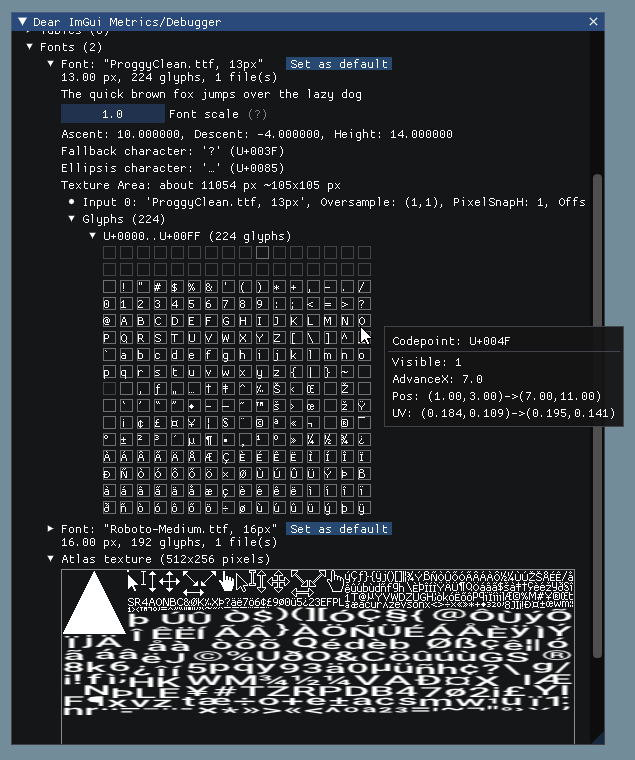 + +#### UTF-8 Encoding Viewer** +You can use the `UTF-8 Encoding viewer` in `Metrics/Debugger` to verify the content of your UTF-8 strings. From C/C++ code, you can call `ImGui::DebugTextEncoding("my string");` function to verify that your UTF-8 encoding is correct. + + + +##### [Return to Index](#index) + +--------------------------------------- + +## Credits/Licenses For Fonts Included In Repository + +Embedded in source code: + +**ProggyClean.ttf**, by Tristan Grimmer +<br>MIT License +<br>(recommended loading setting: Size = 13.0, GlyphOffset.y = +1, PixelSnapH = true) +<br>https://github.com/bluescan/proggyfonts + +**ProggyForever.ttf**, by Disco Hello, Tristan Grimmer +<BR>MIT License +<BR>https://github.com/ocornut/proggyforever + +Extra fonts files are available in the `misc/fonts/` folder. +Compared to 2014 when they were first introduced, we now have better font support and we embed ProggyForever. +I believe all the files here are unnecessary nowadays. You can find font yourself. They might eventually be removed. + +**Roboto-Medium.ttf**, by Christian Robetson +<br>Apache License 2.0 +<br>https://fonts.google.com/specimen/Roboto + +**Cousine-Regular.ttf**, by Steve Matteson +<br>Digitized data copyright (c) 2010 Google Corporation. +<br>Licensed under the SIL Open Font License, Version 1.1 +<br>https://fonts.google.com/specimen/Cousine + +**DroidSans.ttf**, by Steve Matteson +<br>Apache License 2.0 +<br>https://www.fontsquirrel.com/fonts/droid-sans + +**ProggyTiny.ttf**, by Tristan Grimmer +<br>MIT License +<br>(recommended loading setting: Size = 10.0, GlyphOffset.y = +1) +<br>https://github.com/bluescan/proggyfonts + +**Karla-Regular.ttf**, by Jonathan Pinhorn +<br>SIL OPEN FONT LICENSE Version 1.1 + +##### [Return to Index](#index) + +## Font Links + +#### ICON FONTS + +- C/C++ header for icon fonts (#define with code points to use in source code string literals) https://github.com/juliettef/IconFontCppHeaders +- FontAwesome https://fortawesome.github.io/Font-Awesome +- OpenFontIcons https://github.com/traverseda/OpenFontIcons +- Google Icon Fonts https://design.google.com/icons/ +- Kenney Icon Font (Game Controller Icons) https://github.com/nicodinh/kenney-icon-font +- IcoMoon - Custom Icon font builder https://icomoon.io/app + +#### REGULAR FONTS + +- Google Noto Fonts (worldwide languages) https://www.google.com/get/noto/ +- Open Sans Fonts https://fonts.google.com/specimen/Open+Sans +- (Japanese) M+ fonts by Coji Morishita http://mplus-fonts.sourceforge.jp/mplus-outline-fonts/index-en.html + +#### MONOSPACE FONTS + +<img width="1172" height="715" alt="image" src="https://github.com/user-attachments/assets/c9702534-4877-41c9-ae0d-252933c26ced" /> + +- Proggy Fonts, by Tristan Grimmer https://github.com/bluescan/proggyfonts +- Sweet16, Sweet16 Mono, by Martin Sedlak (Latin + Supplemental + Extended A) https://github.com/kmar/Sweet16Font +- Google Noto Mono Fonts: https://www.google.com/get/noto/ +- Typefaces for source code beautification: https://github.com/chrissimpkins/codeface +- Programmation fonts: http://s9w.github.io/font_compare/ +- Inconsolata: http://www.levien.com/type/myfonts/inconsolata.html +- Adobe Source Code Pro: Monospaced font family for ui & coding environments https://github.com/adobe-fonts/source-code-pro +- Monospace/Fixed Width Programmer's Fonts http://www.lowing.org/fonts/ + +Or use Arial Unicode or other Unicode fonts provided with Windows for full characters coverage (not sure of their licensing). + +##### [Return to Index](#index) |